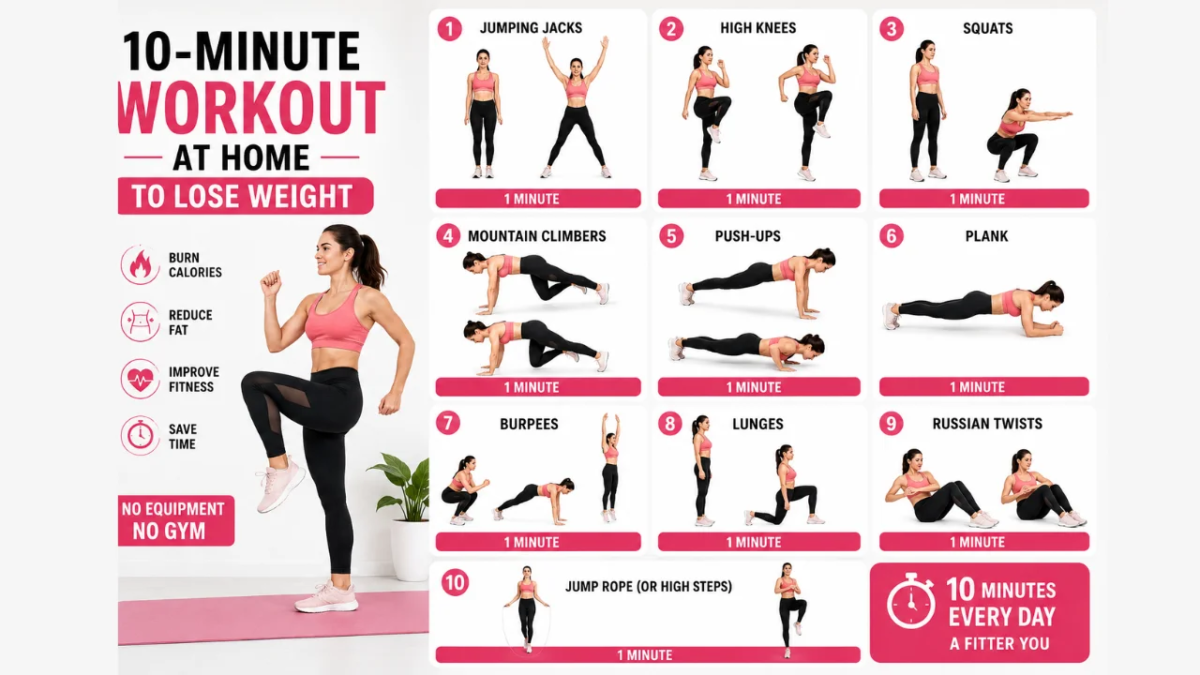
Burn Fat Fast Without a Gym 10-minute workout at home to lose weight is one of the easiest ways to burn fat and stay fit without going to the gym.10-minute workout at home to lose weight is one of the easiest ways to burn fat and stay fit without a gym.
You do not have time. You do not have equipment. You do not have a gym membership. Benefits of a
Good news — you need none of that.
Science proves that a focused is far more effective than 30 minutes of slow cardio. Your body continues burning calories for hours after — even while resting.
Why a 10-Minute Workout at Home to Lose Weight Actually Works
Short intense workouts trigger EPOC — Excess Post-Exercise Oxygen Consumption. This means your body keeps burning fat long after you finish.is one of the best ways to burn fat quickly without gym equipment.
10 focused minutes beats 30 minutes of walking — every single time.
This helps burn calories fast.
A 10-minute workout at home to lose weight is perfect for busy people.
Many beginners try this without gym equipment.
Doing a daily can improve fitness and reduce fat.
The Best
No equipment needed. Do each exercise for 40 seconds, rest 20 seconds, then move on.
Calories burned: 3–5 per minute (massive afterburn)
⏱️ Minute 6 — Reverse Lunges
Step one foot backward
Lower back knee toward floor
Push back and alternate legs
Calories burned: 8–10 per minute
⏱️ Minute 7 — Mountain Climbers
High push-up position
Drive knees toward chest alternately
Go as fast as possible
Calories burned: 10–15 per minute
⏱️ Minute 8 — Glute Bridges
Lie on back, knees bent
Lift hips toward ceiling
Squeeze glutes hard at top
Calories burned: 5–8 per minute
⏱️ Minute 9 — Burpees
Squat down, jump feet back
Do one push-up
Jump feet forward, explode upward
Calories burned: 10–15 per minute
⏱️ Minute 10 — Cool Down Stretching
Quad stretch, hamstring fold
Chest opener, deep breathing This 10-minute workout at home to lose weight helps burn calories fast.
A is perfect for busy people.
Many beginners try this without gym equipment.
Doing a daily can improve fitness and reduce fat.
How Many Calories Does This 10-Minute Home Workout Burn?
Body Weight
Calories Burned
55 kg
80–100 calories
70 kg
100–130 calories
85 kg
130–160 calories
100 kg
160–190 calories
Tips to Maximize Your 10-Minute Workout at Home to Lose Weight
Be Consistent — Do it every single day
Eat Clean — Cut processed foods and sugar
Stay Hydrated — Drink 2–3 liters of water daily
Sleep Well — 7–8 hours for maximum fat burning
Progress Gradually — Add a second round as you get stronger
30-Day Challenge Using This 10-Minute Home Workout to Lose Weight
Week
Goal
Week 1
Once daily
Week 2
Twice daily
Week 3
Workout + 5 min walking
Week 4
Twice daily + clean eating
Frequently Asked Questions
Can a 10-Minute Workout at Home Really Help Lose Weight?
Yes! Consistency is the key. Daily 10-minute high-intensity sessions create a significant calorie deficit over time.
How Soon Will I See Results From a
Most people notice visible changes within 2–3 weeks of daily practice combined with clean eating.
Is This 10-Minute Workout at Home Safe for Beginners?
Absolutely. Every exercise has a beginner modification. Start slow and build intensity gradually. This helps burn calories fast.
A 10-minute workout at home to lose weight is perfect for busy people.
Many beginners try this without gym equipment.
Doing a 10-minute workout at home to lose weight daily can improve fitness and reduce fat.
Final Thoughts
A 10-minute workout at home to lose weight is all you need to start your fitness journey today. No gym. No equipment. No excuses.10-minute workout at home to lose weight
10 minutes a day. 30 days. Life-changing results.
Start right now. 💪 This 10-minute workout at home to lose weight is perfect for beginners.
Many people use this 10-minute workout at home to lose weight without gym equipment.
If you want fast fat burn, try this
Disclaimer: Consult your doctor before starting any new exercise program. 10-minute workout at home to lose weight This 10-minute workout at home to lose weight helps burn calories fast.
A 10-minute workout at home to lose weight is perfect for busy people.
Many beginners try this without gym equipment.
Doing a daily can improve fitness and reduce fat. Benefits of a
This 10-minute workout at home to lose weight helps burn calories fast.
A 10-minute workout at home to lose weight is perfect for busy people.
Many beginners try this without gym equipment.
Doing a 10-minute workout at home to lose weight daily can improve fitness and reduce fat. This 10-minute workout at home to lose weight is simple and beginner friendly.
Many people choose a because it saves time and improves fitness.
Doing a every day can help reduce belly fat and increase stamina.
How to Sleep Better Without Pills Naturally (2026 Guide)
Millions of people struggle with poor sleep every night. Before reaching for sleeping pills — which can cause dependency and side effects — there are powerful, proven natural methods to help you sleep deeper, longer, and more restfully.how to sleep better without pills
🌙 Why Sleep Matters More Than You Think
Sleep is not just rest. It’s when your body:
Repairs muscles and tissues
Consolidates memory and learning
Regulates hormones and metabolism
Strengthens your immune system how to sleep better without pills
Chronic poor sleep is linked to heart disease, obesity, depression, and even early death. Getting it right naturally is one of the best investments in your health.
✅ Top Natural Ways to Sleep Better
1. Fix Your Sleep Schedule how to sleep better without pills
Your body runs on a circadian rhythm — an internal 24-hour clock. Going to bed and waking up at the same time every day (even weekends) is the single most powerful sleep habit you can build.
Tip: Set a “bedtime alarm” 30 minutes before sleep as a reminder to wind down.how to sleep better without pills
2. Limit Blue Light After Sunset
Phones, laptops, and TVs emit blue light that tricks your brain into thinking it’s daytime, suppressing melatonin production.
What to do:
Use Night Mode or blue light glasses after 8 PM
Stop screen use 1 hour before bed
Read a physical book instead
3. Make Your Bedroom a Sleep Sanctuary
Your environment sends powerful signals to your brain.
Factor
Ideal Condition
Temperature
18–20°C (65–68°F)
Light
Complete darkness
Sound
Silent or white noise
Bedding
Clean, comfortable, breathable
Pro tip: Use blackout curtains and an eye mask for maximum darkness.
4. Try the 4-7-8 Breathing Technique
This simple breathing exercise activates your nervous system’s rest response:
Inhale through your nose for 4 seconds
Hold your breath for 7 seconds
Exhale slowly through your mouth for 8 seconds
Repeat 4 times
It lowers heart rate and anxiety within minutes.
5. Natural Sleep-Boosting Foods & Drinks
What you eat affects how you sleep.
Eat more of:
🍒 Tart cherries — natural melatonin source
🍌 Bananas — magnesium and tryptophan
🥜 Almonds & walnuts — promote melatonin production
🥛 Warm milk — classic tryptophan boost
Avoid before bed:
☕ Caffeine (stop by 2 PM)
🍷 Alcohol (disrupts deep sleep)
🍕 Heavy, spicy meals within 2–3 hours of sleep
6. Magnesium — Nature’s Relaxation Mineral
Magnesium deficiency is extremely common and directly linked to poor sleep. It calms the nervous system and promotes deep, restorative sleep.
Sources:
Magnesium glycinate supplement (best absorbed)
Dark leafy greens (spinach, kale)
Pumpkin seeds, dark chocolate
7. Exercise — But Time It Right
Regular physical activity significantly improves sleep quality. However, timing matters:
✅ Morning or afternoon exercise — boosts sleep quality
⚠️ Intense exercise within 2 hours of bed — can delay sleep
Even a 20–30 minute walk daily makes a measurable difference.
8. Manage Stress and Anxiety Before Bed
Racing thoughts are one of the biggest sleep killers. Try these before bed:
Journaling — Write down tomorrow’s tasks to “offload” your mind
Meditation — Even 10 minutes with apps like Calm or Headspace
Gratitude practice — Write 3 things you’re grateful for
Progressive muscle relaxation — Tense and release each muscle group from toes to head
9. Natural Herbal Remedies That Work
These herbs have scientific backing for improving sleep:
Herb
Benefit
Ashwagandha
Reduces cortisol, eases anxiety
Valerian Root
Shortens time to fall asleep
Passionflower
Calms an overactive mind
Chamomile Tea
Mild sedative effect, reduces anxiety
Lavender
Aromatherapy lowers heart rate
10. Sunlight in the Morning
Getting 10–15 minutes of natural sunlight within an hour of waking sets your circadian rhythm for the entire day. It tells your brain when to be alert — and more importantly, when to sleep later.
No sunlight in the morning = harder to fall asleep at night.
11. The Military Sleep Method
Developed to help soldiers fall asleep in 2 minutes under any conditions:how to sleep better without pills
Relax your entire face — jaw, tongue, eyes
Drop your shoulders and hands
Exhale and relax your chest
Relax your legs, calves, and feet
Clear your mind for 10 seconds — imagine a calm scene
Sleep arrives within 2 minutes with practice
12. Limit Naps Strategically
Long or late naps destroy nighttime sleep quality.
✅ Keep naps to 20–30 minutes
✅ Nap before 3 PM
❌ Avoid naps if you have insomnia
🚫 Habits That Secretly Ruin Your Sleep
Checking your phone in the middle of the night
Watching the clock anxiously
Working from bed (your brain associates bed with work, not sleep)
Drinking too much water right before bed
Inconsistent wake-up times on weekends how to sleep better without pills
🗓️ Your Natural Sleep Routine (Sample)
Time
Activity
7:00 AM
Wake up + 15 min sunlight exposure
2:00 PM
Last caffeine cutoff
7:00 PM
Light dinner
8:30 PM
Blue light off, dim lights
9:00 PM
Journal + herbal tea
9:30 PM
Reading or meditation
10:00 PM
Lights out, 4-7-8 breathing
💬 Final Thoughts
You don’t need pills to sleep well. Your body already knows how to sleep — it just needs the right conditions and habits to do so. Start with one or two changes from this list, build consistency, and within 2–3 weeks, you’ll notice a dramatic improvement.
Better sleep is not a luxury. It’s the foundation of a better life.
The weight loss supplement industry is worth tens of billions of dollars — and growing every year. Walk into any pharmacy or scroll through your social media feed, and you’ll find hundreds of products promising to melt fat, suppress appetite, or turbocharge your metabolism. But with so many options and even more marketing claims, how do you know what’s actually backed by science and what’s just clever advertising? Many of the best weight loss supplements claim fast results, but not all are backed by science.Natural
This guide breaks down the most popular weight loss supplements on the market, what the research actually says about them, potential risks to be aware of, and how to make a smarter, safer decision for your health. best weight loss supplements https://www.healthline.com/nutrition/best-weight-loss-supplements
What Are Weight Loss Supplements?
Weight loss supplements are products — pills, powders, capsules, or liquids — that claim to help you lose weight by one or more of the following mechanisms:
Reducing appetite so you eat fewer calories
Blocking fat or carbohydrate absorption in the gut
Increasing metabolism so you burn more calories at rest
Boosting energy so you exercise more effectively
Unlike prescription weight loss medications, most supplements are not regulated as drugs by health authorities like the FDA (in the United States) or the CDSCO (in India). This means they don’t have to prove they work or even that they’re safe before hitting store shelves. That distinction matters enormously when evaluating what you’re putting into your body.best weight loss supplements
The Most Common Weight Loss Supplements — and What Science Says Best Weight Loss Supplements Backed by Science
1. Caffeine best weight loss supplements
Caffeine is arguably the most studied and well-supported ingredient in the weight loss world. It’s a natural stimulant found in coffee, tea, and many pre-workout formulas.
What the research shows: Caffeine can modestly boost metabolic rate and increase fat oxidation, particularly during exercise. Studies suggest it may improve exercise performance by 11–12%, which can translate to more calories burned per session.
Limitations: The effects are short-lived. Your body builds a tolerance to caffeine relatively quickly, meaning the metabolic boost diminishes over time. Relying on caffeine for weight loss without dietary changes or exercise will produce minimal results.
Risks: High doses can cause anxiety, insomnia, elevated heart rate, and dependency. People sensitive to stimulants should proceed cautiously.best weight loss supplements
2. Green Tea Extract Best Weight Loss Supplements Backed by Science
Green tea extract is one of the most popular ingredients in fat-burning supplements. It contains both caffeine and a class of antioxidants called catechins — particularly EGCG (epigallocatechin gallate) — which are believed to work synergistically.
What the research shows: Some studies suggest green tea extract can increase fat oxidation and slightly raise metabolic rate. A meta-analysis published in the International Journal of Obesity found modest but statistically significant reductions in body weight among participants taking green tea supplements.
Limitations: The weight loss effect is generally small — often just 1–3 kg over 12 weeks — and may not be clinically meaningful on its own. Results vary widely between individuals.
Risks: In high doses, green tea extract has been linked to liver toxicity. Always stick to recommended dosages and avoid combining multiple supplements containing this ingredient.
3. Protein Supplements (Whey, Casein, Plant-Based)
While not always marketed specifically as “weight loss” products, protein supplements deserve a prominent place on this list — because the evidence behind them is genuinely strong.
What the research shows: High protein intake is consistently associated with reduced appetite, better muscle preservation during calorie restriction, and a slightly higher metabolic rate due to the thermic effect of food. Replacing a meal with a high-protein shake can reduce overall calorie intake without leaving you feeling deprived.
Limitations: Protein supplements are tools, not magic. They work best when used to fill a genuine gap in dietary protein — not as an addition to an already high-calorie diet.
Risks: Generally very safe. Those with kidney disease should consult a doctor before significantly increasing protein intake.best weight loss supplements
Glucomannan is a natural dietary fiber derived from the root of the konjac plant. It absorbs water and expands in the gut, which can promote feelings of fullness.
What the research shows: Clinical trials have shown that glucomannan, when taken before meals with plenty of water, can reduce body weight, improve cholesterol levels, and lower blood sugar. It’s one of the more credible fiber-based weight loss supplements available.
Limitations: It must be taken correctly — with adequate water — to be effective and safe. Results are modest without accompanying dietary changes.
Risks: Can cause bloating, gas, or digestive discomfort. There’s a rare but serious risk of esophageal blockage if taken without sufficient water, particularly in tablet form.best weight loss supplements
5. Conjugated Linoleic Acid (CLA)
CLA is a type of fatty acid found naturally in meat and dairy from grass-fed animals. It’s widely marketed as a fat burner.
What the research shows: Some animal studies showed impressive fat-reducing effects, which sparked interest in CLA supplements for humans. However, human clinical trials have been far less impressive — showing modest reductions in body fat, often less than 1 kg over several months.
Limitations: The results seen in animal models simply haven’t translated well to humans. The doses required to see any effect are high, and the benefits are minimal.best weight loss supplements
Risks: Some research suggests that long-term CLA supplementation may negatively affect insulin sensitivity and increase inflammatory markers in some individuals.
6. Garcinia Cambogia
Few supplements have been more aggressively marketed — or more disappointing in clinical trials — than Garcinia cambogia. Derived from a tropical fruit, it became a household name after being featured on popular health television shows.
What the research shows: The active ingredient, hydroxycitric acid (HCA), was theorized to suppress appetite and block fat production. However, rigorous clinical trials have found little to no significant effect on weight loss compared to placebo.
Limitations: The hype vastly outpaces the evidence. Most well-designed studies show no meaningful weight loss benefit.
Risks: Liver toxicity has been reported in some cases, particularly at high doses. This is a supplement worth skipping.best weight loss supplements
7. Berberine
Berberine is a compound extracted from several plants and has been used in traditional medicine for centuries. More recently, it has attracted scientific attention for its effects on blood sugar and metabolism.
What the research shows: Berberine activates an enzyme called AMPK, sometimes called a “metabolic master switch.” Studies have shown it can lower blood sugar, improve insulin sensitivity, and lead to modest weight loss — with some trials comparing its effects to metformin, a prescription diabetes medication.
Limitations: Most studies are small and short-term. Long-term data in healthy (non-diabetic) individuals is limited.best weight loss supplements
Not all supplements are created equal. Here are warning signs that a product may not be trustworthy:
“Clinically proven” without citing peer-reviewed research — This phrase is often used loosely and means little without context.
Proprietary blends with undisclosed dosages — If you can’t see how much of each ingredient is in a product, you can’t evaluate its safety or efficacy.
Before and after photos as primary evidence — Individual results can be explained by any number of factors and prove nothing about the supplement itself.
Claims that sound too good to be true — No supplement causes significant weight loss without dietary changes. Period.
No third-party testing certification — Look for certifications from organizations like NSF International, Informed Sport, or USP, which verify that products contain what they claim.
Supplements, at best, can offer a modest edge in support of these fundamentals. They are not a shortcut, and treating them as one often leads to disappointment — and sometimes harm.
Before You Buy: Key Questions to Ask
Is there peer-reviewed evidence for this specific ingredient?
Does the product disclose exact ingredient dosages?
Has it been third-party tested for purity and potency?
Are there any interactions with medications I currently take?
Have I spoken to a healthcare professional?
Consulting with a registered dietitian or your doctor before starting any supplement regimen is always the wisest move — especially if you have underlying health conditions or take medications.
The Bottom Line
The weight loss supplement market is full of noise, exaggeration, and outright misinformation. But within it, a small number of ingredients — caffeine, green tea extract, protein, glucomannan, and berberine — have reasonable evidence supporting modest benefits when used correctly and in combination with a healthy lifestyle.best weight loss supplements
Approach supplements with healthy skepticism. Invest more energy in building sustainable habits around food, movement, sleep, and stress — and if you do use supplements, choose ones backed by credible research, made by transparent companies, and approved by a healthcare professional.
Your health is worth more than a flashy label and an empty promise.best weight loss supplements
Disclaimer: This article is for informational purposes only and does not constitute medical advice. Always consult a qualified healthcare professional before starting any supplement regimen.
Creating an effective workout plan for losing weight doesn’t require expensive gym memberships or complicated equipment. Research shows that bodyweight exercises deliver similar benefits to traditional gym workouts, including improved cardiovascular fitness. Experts recommend at least 150 minutes of moderate-intensity exercise or 75 minutes of vigorous activity weekly, plus two days of strength training. In this guide, I’ll walk you through the best at home workouts for weight loss, including resistance training to lose weight and compound exercises for weight loss. We’ll cover everything from setting up your space to following a complete weight loss workout plan with exercises at home for weight loss. This home workout for weight loss is perfect for beginners
You don’t need to replicate a commercial gym in your living room. According to fitness experts, building an effective home workout space starts with understanding what equipment supports compound movements and delivers the most versatility for your investment. this home workout for weight loss is perfect for beginners
Essential Equipment You Actually Need
Prioritizing your equipment purchases prevents wasted money on gadgets that collect dust. I recommend following a tier system that focuses on functionality over flashy promises: follow this home workout for weight loss daily Best Home Workout Plan for Weight Loss
Tier 1 (The Foundation): Dumbbells and resistance bands form your essential base. If you only buy one thing for your weight loss workout plan, make it a set of dumbbells. Free weights force your body to stabilize the weight rather than relying on a machine, allowing you to perform hundreds of exercises including squats, lunges, and presses. Start with light, medium, and heavy weights appropriate for your fitness level.home workout for weight loss helps burn fat fast
Resistance bands provide similar strength gains to traditional weights while costing significantly less. These versatile tools allow you to perform compound exercises for weight loss through the entire range of motion.this guide shows the best home workout for weight loss
Tier 2 (The Accelerators): Once you’ve established consistency, a rowing machine engages 85% of your muscles in a single movement, including legs, core, and back. For changing body composition, a squat rack and barbell enable safe, heavy compound lifts like squats and deadlifts.
Tier 3 (Optional): Kettlebells, exercise mats, jump ropes, and benches add variety but aren’t required initially. Skip vibrating plates and ab gadgets entirely. You cannot spot reduce fat from your stomach, and heavy squats will do more for your core than 1,000 crunches on a plastic gadget.
Budget-Friendly Equipment Alternatives
You can build a functional home gym for as little as USD 100 to USD 300 by focusing on essentials. Due to rising equipment costs, creative alternatives make fitness accessible without breaking the bank.
Water bottles and laundry detergent bottles work as weights. Soup cans substitute for hand weights, and a pillow can replace an exercise ball. A chair, countertop, couch, or ottoman provides support for bodyweight exercises. Similarly, a towel or blanket serves as a yoga mat until you invest in dedicated equipment.this home workout for weight loss is perfect for beginners” “follow this home workout for weight loss daily” “home workout for weight loss helps burn fat fast” “this guide shows the best home workout for weight loss
Shop sales during Black Friday or New Year promotions for significant discounts. Many affordable fitness brands offer quality starter kits for beginners. If you’re handy, create your own sandbags or plyometric boxes for a fraction of retail prices.
Creating a Dedicated Workout Area
Your workout zone should fit your space, not the other way around. A 7-foot-by-7-foot area provides enough room to lie down and move around for most at-home workouts. A spare bedroom offers plenty of options, but a corner of your living room, basement, garage, or covered patio works just as well.
Measure your space carefully before purchasing equipment. An ideal workout area should offer room to move around without overcrowding. For smaller spaces, opt for adjustable dumbbells, resistance bands, and foldable benches that minimize your footprint while maximizing exercise variety.
Wall-mounted storage shelves keep yoga mats, foam rollers, and resistance bands organized. Floor storage racks work well if you prefer avoiding wall holes. Foldable or stackable gear maintains organization in tight quarters.
Make your space inviting. Add motivational pictures or quotes, bring in extra lights, include a speaker for music, or mount a mirror. You should feel drawn to your exercise area. In other words, create an environment where you want to spend time, not one that feels like a chore to enter.
Understanding Your Weight Loss Workout Plan
Your workout frequency matters more than the length of individual sessions. The Physical Activity Guidelines for Americans recommend at least 150 minutes of moderate aerobic activity or 75 minutes of vigorous aerobic activity weekly, plus two days of strength training for all major muscle groups. This breaks down to manageable chunks: 30 minutes of cardio five days per week, or 25 minutes six days per week.
How Many Days Per Week You Should Train
Most people see the best results working out three to five days per week. This range supports calorie burn while allowing proper recovery between sessions. If you commit to working out at least four to five days weekly, you’ll see results reflected on the scale and continue making progress over time.
Starting from zero and jumping to daily workouts sets you up for exhaustion and poor performance. Instead, begin with 20 to 30 minutes, two to three days each week, then expand to longer and more frequent workouts as you gain confidence and strength. Your body needs time to adapt. Grueling 90-minute sessions aren’t beneficial for anyone. That time works better split into shorter, more frequent sessions[83].
Consistency drives results more reliably than occasional marathon workouts. Weekly activity totals matter more than hitting an exact daily number. When progress is measured across the week, missing one workout doesn’t derail everything. You simply adjust by adding a longer walk another day or shifting a strength session to the weekend.
Balancing Cardio and Strength Training
Combining cardiovascular exercise and strength training produces faster, more sustainable weight loss than either alone. A balanced approach ensures you get benefits from both: cardio burns calories during exercise, while strength training builds muscle that increases your metabolism even at rest.
Aim for two to three days of cardio and two to three days of strength training each week, with two rest days regardless of which combination you choose. You can structure your week with separate days for each type, or combine both into one workout through circuit training or high-intensity interval training.
For strength sessions, focus on completing enough repetitions at sufficient weight to fatigue your muscles after about 12 to 15 repetitions. Two full-body strength workouts per week work well for most people aiming to lose weight because they provide enough stimulus without crushing recovery. Space these sessions out when possible, like Monday and Thursday, or Tuesday, Thursday, and Saturday.
Setting Realistic Weekly Goals
People who lose weight at a gradual, steady pace of 1 to 2 pounds per week maintain their results better than those who lose weight faster. This requires cutting daily calories by 500 to 750 while moving more.
Set specific, behavior-focused goals rather than vague intentions. Instead of “exercise more,” commit to “walk 15 minutes, three days per week for the first week”. These concrete targets allow you to track progress and stay motivated. Similarly, focusing on weekly exercise targets offers flexibility that daily goals lack. Life happens, work runs late, and energy levels fluctuate.
Sessions should range between 30 and 90 minutes depending on activity. The routine you choose needs to suit your lifestyle so you can maintain it long-term. Sustainable weight loss isn’t linear. Progress comes in fits and starts, and that’s normal.
Selecting the right movements determines whether your workout plan for losing weight delivers results or wastes effort. The exercises I recommend target multiple muscle groups simultaneously, burn maximum calories, and build lean tissue that keeps your metabolism elevated long after you finish.
Compound movements engage several muscle groups at once, making them superior for fat loss. Bodyweight squats utilize your leg muscles, which require high caloric expenditure to contract and perform work. Push-ups challenge your upper body and core simultaneously, expending more calories than working a single muscle group alone.
Walking lunges combine aerobic conditioning with strength training for powerful calorie burning. Lateral lunges target the glutes rather than the quads, adding variety to your lower body work. Burpees get you sweating and fire up your heart rate quickly. Mountain climbers target your core and upper body while delivering cardio benefits.
Dips offer a convenient way to hit your chest, shoulders, and triceps at once. Targeting multiple muscle groups expends calories more efficiently than isolation work. Glute bridges work the muscles around your hips and help you build lean muscle tissue in an area that tends to hold onto fat.
Bodyweight Cardio Exercises
Jumping jacks increase your calorie expenditure while challenging your aerobic system, balance, and coordination. High knees rapidly drive your knees upward, elevating your heart rate and building lower-body explosiveness. Skater jumps mimic the lateral movement of speed skaters, improving balance, coordination, and agility while boosting cardio.
Butt kicks target the hamstrings and increase stride speed. Jump squats add an explosive element to basic squats, burning calories and building strength simultaneously. Plank jacks start in a plank position and jump your feet out and in like a horizontal jumping jack, engaging your core while elevating your heart rate.
Resistance Training to Lose Weight
Strength training creates an EPOC (Excess Post-exercise Oxygen Consumption) effect, meaning your body continues burning calories for hours after you finish. Building lean muscle raises your resting metabolic rate because muscle tissue burns more calories at rest than fat mass.
Focus on compound movements that engage multiple major muscle groups. Bodyweight exercises like squats, push-ups, and lunges provide excellent starting points. Progressive overload remains essential for fat loss, so continue adding repetitions as workouts become easier.
Core Strengthening Movements
Core exercises strengthen the abdominal muscles, back muscles, and muscles around the pelvis. Planks build muscles in the abdomen, back, and side simultaneously. Side planks work your obliques and contribute to balanced core muscles.
Dead bugs target the deep abdominal muscles to build a stronger core while challenging your upper and lower body coordination. Glute bridges (also called back bridges) raise your hips off the floor until your hips line up with your knees and shoulders. The quadruped exercise, sometimes called the bird dog, starts on your hands and knees and involves raising opposite arm and leg.
Your Complete 4-Week Weight Loss Workout Plan
This weight loss workout plan runs five training days and two rest days each week. The structure includes three strength sessions and two cardio sessions. If five days feels overwhelming initially, drop to four and add the fifth when you’re ready. The framework stays constant across all four weeks, but intensity increases progressively.
Week 1-2: Building Your Foundation
Your first two weeks focus on learning movements and establishing consistency. Start with 2-3 sets of 10-12 repetitions using moderate weight. Week one emphasizes proper form above all else. For cardio, perform 25-30 minutes of steady-state work and 15 minutes of HIIT.
Week two maintains the same rep range but allows you to increase weight where form permits. Correspondingly, extend steady cardio to 30-35 minutes and HIIT to 18 minutes. You’re still building the habit at this point, so focus on showing up consistently rather than pushing maximum intensity.
Week 3-4: Increasing Intensity
Week three shifts to 3-4 sets of 8-10 reps with heavier loads. Fewer reps with more weight triggers strength gains and muscle growth. Steady-state cardio extends to 35-40 minutes while HIIT reaches 20 minutes.
Week four represents your peak effort. Complete 4 sets of 8-10 reps with the heaviest weight you’ve used yet. Push yourself to test limits and measure progress. Cardio sessions hit 40 minutes for steady work and 25 minutes for HIIT.
Sample Weekly Schedule
Monday and Saturday target full-body workouts using compound movements. Thursday focuses on either upper or lower body splits, alternating each week. Keep reps between 8-12 and rest 60-90 seconds between sets.
Tuesday delivers steady-state cardio at a conversational pace for 30-40 minutes. Friday switches to high-intensity intervals with 30 seconds on, 30 seconds off.
Wednesday and Sunday are rest days where light movement like yoga, walking, or stretching helps recovery without adding training stress.
Exercise forms only half of your weight loss workout plan. What you eat, how you recover, and how you track progress determine whether your efforts translate into lasting results.
Nutrition Basics for Home Workouts
Eat breakfast at least one hour before morning workouts to fuel performance. Focus on carbohydrates like whole-grain cereals, low-fat milk, bananas, or yogurt. For workouts longer than 60 minutes, consume 30 to 90 grams of carbohydrates per hour through options like low-fat yogurt, raisins, or bananas. Post-workout, eat a meal with both carbohydrates and protein within two hours to help muscles recover and replace glycogen stores. Drink roughly 2 to 3 cups of water during the 2 to 3 hours before exercise, then about 1/2 to 1 cup every 15 to 20 minutes during your workout.
Recovery and Rest Days
Rest days allow your muscles, connective tissues, and joints to heal from microscopic damage caused by resistance training to lose weight. Active people should eat at least 1.6 grams of protein per kilogram of body weight daily to support muscle repair during rest. Take at least one rest day from intense workouts each week. High-intensity work without sufficient rest elevates cortisol levels, which promotes fat storage around the abdomen.
Tracking Your Progress
Tracking calories and exercise consistently proves effective for weight management. Body measurements often show progress faster than scale weight, especially when building muscle and losing fat simultaneously. Focus on skeletal muscle mass, body-fat percentage, and visceral fat rather than weight alone. Track intuitive markers like sleep quality, energy levels, and stress resilience on a scale of 1-10.
Staying Motivated Without a Gym
Motivation fluctuates, but discipline sustains progress. Habit formation requires approximately 66 days of consistent practice. Action precedes motivation, not the reverse. Connect your fitness routine to something deeper than appearance by identifying your personal reason for exercising. Keep a daily log noting small wins like “moved my body intentionally” or “talked to someone new”.
Conclusion
Building an effective weight loss workout plan at home doesn’t require expensive equipment or complicated routines. As shown above, bodyweight exercises and minimal gear deliver real results when you stay consistent. The 4-week plan I’ve shared gives you everything needed to start burning fat and building strength from your living room.
Above all, remember that showing up matters more than perfection. Start with two or three days per week, focus on proper form, and gradually increase intensity as your body adapts. Combined with smart nutrition and adequate rest, these at-home workouts will help you reach your weight loss goals without ever stepping foot in a gym. Check our belly fat loss guide here
Health Profit Hub
We help you achieve your health and fitness goals with trusted tips, workouts, and honest reviews.
“This website contains affiliate links. If you click and make a purchase, we may receive a small referral fee at no extra cost to you. This helps us keep the site running and continue providing honest reviews. We only recommend products we genuinely believe in. Individual results may vary.”